Article
The Shenmue Saga: Yu Suzuki's ambition, the long wait and the unfinished dream
From Virtua Fighter RPG to Shenmue III, the story of Yu Suzuki's cult saga, its Dreamcast shock, its long silence and its Kickstarter return.

A saga born from an obsession with detail
Shenmue is one of those series that cannot be reduced to a technical checklist. It is an adventure game, a daily-life simulator, a martial arts revenge story, a walk through late-1980s Japan, an industrial project too ambitious for its time and a narrative promise left hanging for years.
Its creator, Yu Suzuki, was already one of Sega's defining figures. Before Shenmue, he helped shape modern arcade design with Hang-On, Space Harrier, Out Run, After Burner, Virtua Racing and, above all, Virtua Fighter. With Shenmue, Suzuki was no longer chasing the immediate thrill of a short arcade session. He wanted a world where the player could exist, wait, ask questions, work, spend money, collect capsule toys, watch the weather and slowly move through an investigation.

From Virtua Fighter RPG to Project Berkley
Shenmue did not begin as Shenmue. It grew from the idea of a Virtua Fighter RPG, initially connected to Akira Yuki. Development began in the orbit of the Saturn, then moved to Dreamcast as Sega prepared its next console.
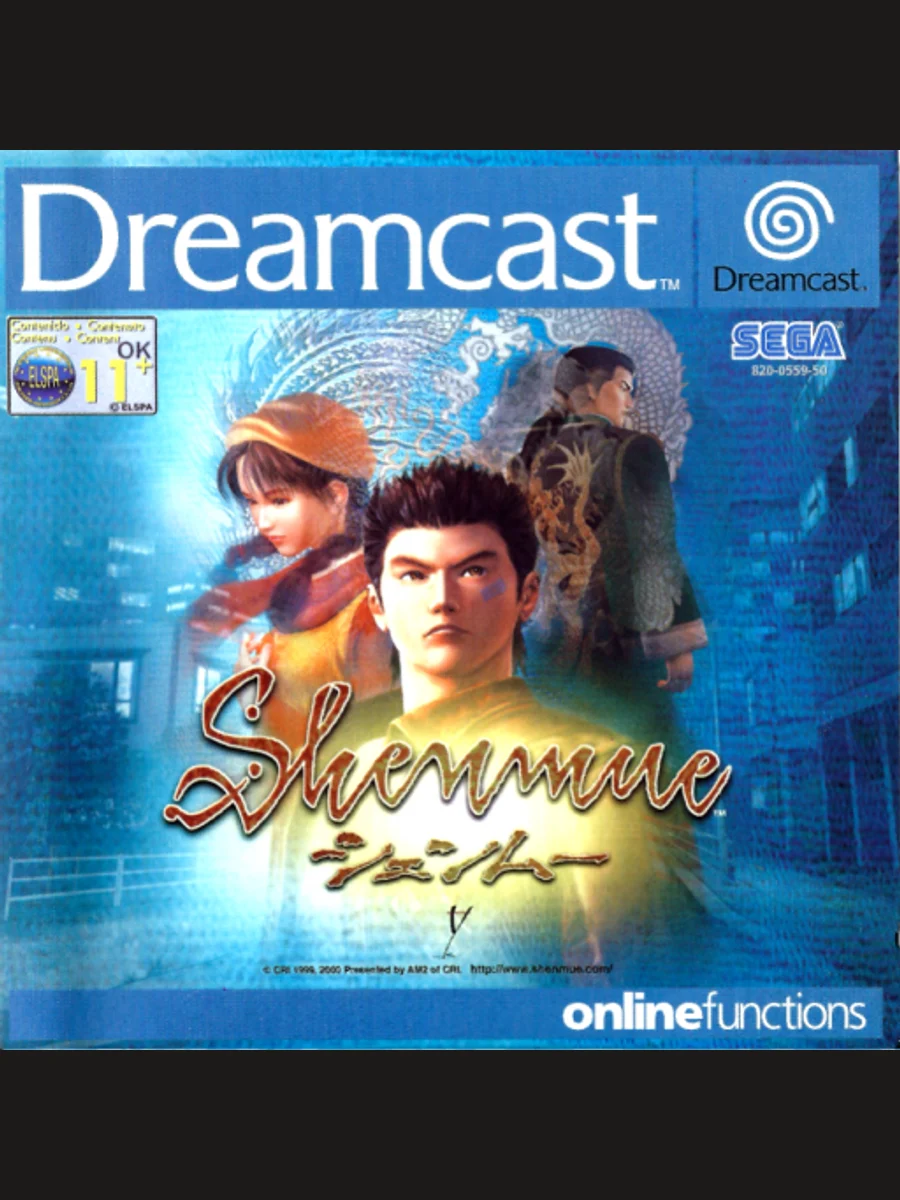
The codename Project Berkley appeared before the game found its final identity. That transition matters: Shenmue gradually dropped the direct Virtua Fighter link and became the story of Ryo Hazuki, a young martial artist from Yokosuka. The premise is simple and tragic: Ryo sees his father Iwao killed by Lan Di, who steals the mysterious Dragon Mirror. Ryo follows the trail, unaware that his revenge story is part of something much larger.
Shenmue, Dreamcast's 1999 shock
Released in Japan on December 29, 1999 for Dreamcast, then in the West in 2000, Shenmue was presented as a new kind of experience. Sega called it FREE, for Full Reactive Eyes Entertainment. Behind the odd label was a real ambition: make every street, shop, resident and day feel as if it existed even when the player was not looking.
The first game is set in Yokosuka, especially Dobuita and the surrounding areas. It impressed players with NPC routines, detailed interiors, day-and-night cycles, changing weather, playable Sega arcade machines, inspectable objects and a deliberately everyday rhythm. Ryo does not save the world in ten minutes. He asks for a name, waits for an appointment, works as a forklift driver, learns a move, and returns home before night.
Why the first game mattered
Looking back, Shenmue anticipated many ideas that became central to action-adventure games and open worlds: a dense urban space, scheduled characters, a quest notebook, integrated mini-games, a local economy, collectibles and a strong sense of place. It also popularized QTEs as a cinematic tool: the player did not only watch a chase or a choreographed fight, but had to react.
Yet Shenmue was not only modern. It was slow, stiff and almost stubborn. That is part of its fascination. It asked the player to accept time, repetition and observation. It turned waiting into a game mechanic. This boldness created deep admiration, but also commercial confusion.
Shenmue II, Hong Kong, Kowloon and a wider journey
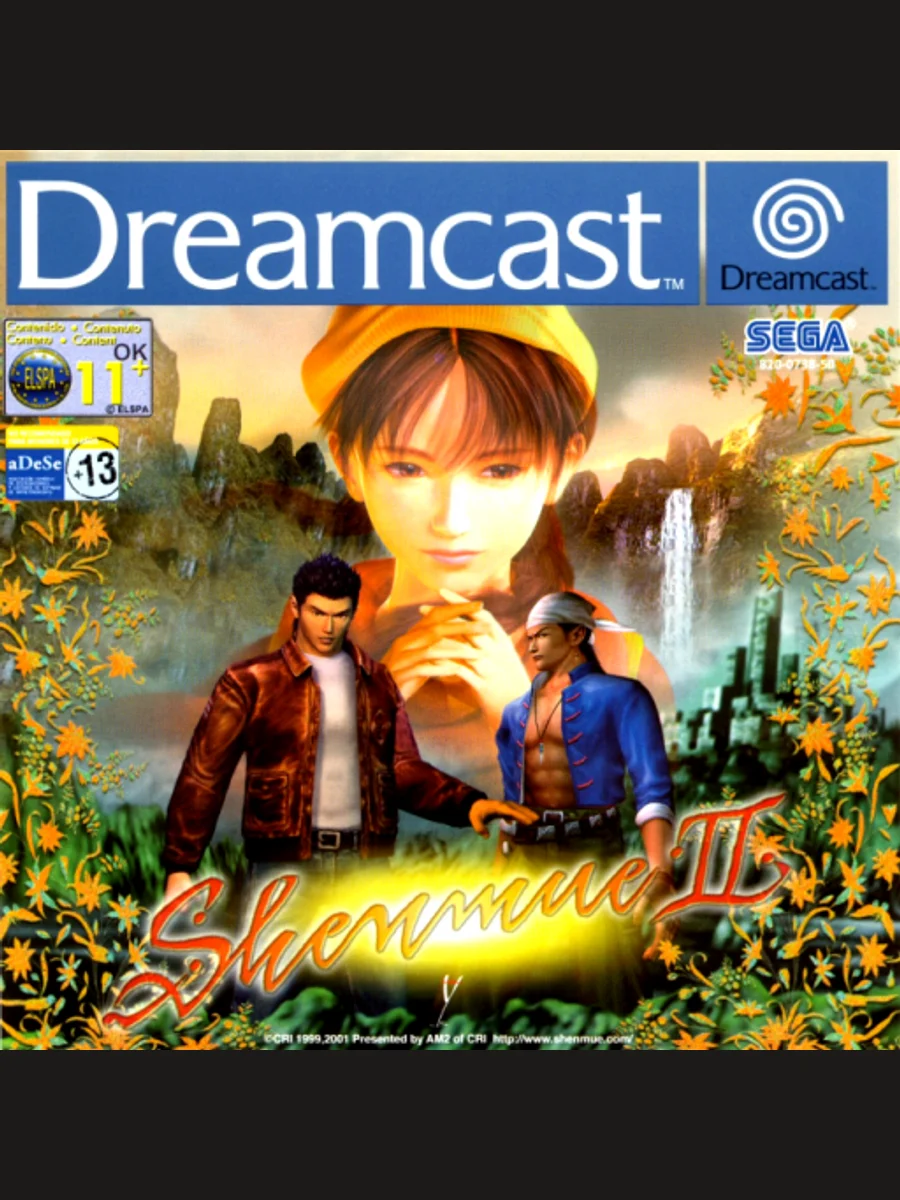
Shenmue II arrived on Dreamcast in 2001 in Japan and Europe. In North America, it became best known through the Xbox version in 2002. Where the first game kept Ryo inside an intimate Japanese setting, Shenmue II opened the horizon: Hong Kong, Wan Chai, Aberdeen, Kowloon and finally Guilin.
The rhythm changed. The game was larger, denser and more adventurous. Ryo met Joy, Wong, Ren, Xiuying and Shenhua, while the story around the Dragon and Phoenix mirrors became more mythical. Jobs were still present, but money could also come from gambling, street fighting and side activities. The series moved from a neighborhood investigation to an initiation journey.
The abrupt stop after the second episode
Shenmue's problem was cruel: the series became cult because it was ahead of its time, but it arrived at the worst commercial moment for Sega. Dreamcast could not withstand PlayStation 2, Sega left the console hardware business, and Shenmue's development costs became part of the legend.
Shenmue and Shenmue II were praised, but did not sell enough to make a costly continuation easy to justify. The story stopped just as Ryo reached the heart of the mystery. For years, Shenmue III became a myth: requested on forums, mentioned in interviews, expected at every major show, but never announced.
The long wait and the Shenmue cult
That wait turned Shenmue into something unusual. Fans did not simply miss a game; they preserved a shared memory. They spoke about Dobuita as if it were a real place, forklift work as a ritual, capsule toys as a scent of the era. Ryo Hazuki even appeared in other Sega productions, including Sonic & Sega All-Stars Racing, a funny and slightly painful wink at the same time.
In 2018, Shenmue I & II returned on PC, PlayStation 4 and Xbox One. The compilation updated controls, interface and display options while preserving the texture of the originals. It allowed a new generation to understand why Shenmue matters, and also why it divides players.
Shenmue III, the impossible return through Kickstarter
The turning point came at E3 2015. Yu Suzuki appeared during Sony's conference and announced a Kickstarter campaign for Shenmue III. For fans, it felt almost unreal. The campaign reached its initial goal quickly, then passed six million dollars with nearly 70,000 backers.
Crowdfunding did not mean the entire game depended only on Kickstarter; publishing and production partners also mattered. But symbolically, Shenmue III became the game fans brought back to life. It finally launched on November 19, 2019 for PlayStation 4 and PC, developed by Ys Net with Yu Suzuki leading the project.
Shenmue III: faithful or out of time?
Shenmue III continues in Bailu, in the Guilin region, with Ryo and Shenhua. It deliberately keeps much of Shenmue's DNA: slow rhythm, training, conversations, mini-games, observation, combat and clue hunting. That is both its strength and its limit.
For some players, Shenmue III is a love letter: it refuses to turn Shenmue into a standardized modern open world. For others, it feels dated, awkward and narratively modest after eighteen years of waiting. The truth may sit between the two. Shenmue III is less a revolution than a resumed conversation with fans who never really left Ryo behind.
What now?
The story is still not complete. Yu Suzuki has often expressed the desire to continue, but Shenmue IV has not yet become an official industrial certainty. Shenmue III Enhanced, planned for modern platforms, at least shows that the license is not frozen.
Shenmue remains a paradox: too slow for some, precious for others; technically dated in places, emotionally unique; costly, imperfect, influential and irreplaceable. It reminds us that a game can be great not only because of what it achieves, but because of what it attempts. And Shenmue attempted something enormous.
Published on June 22, 2026
Retrogaia
Related games
Retrogaia
Also read on Retrogaia

Rise and fall of Atari consoles
From Pong and the Atari 2600 to the 1983 crash, Lynx and Jaguar: the brilliant, chaotic story of Atari hardware.
Crash Bandicoot: the making of a PlayStation mascot
From Willy the Wombat to PlayStation icon: the creation, success, games and legacy of Crash Bandicoot.
Everything you need to know about the AES+
Neo Geo AES is coming back as a modern cartridge-compatible console for players and collectors.